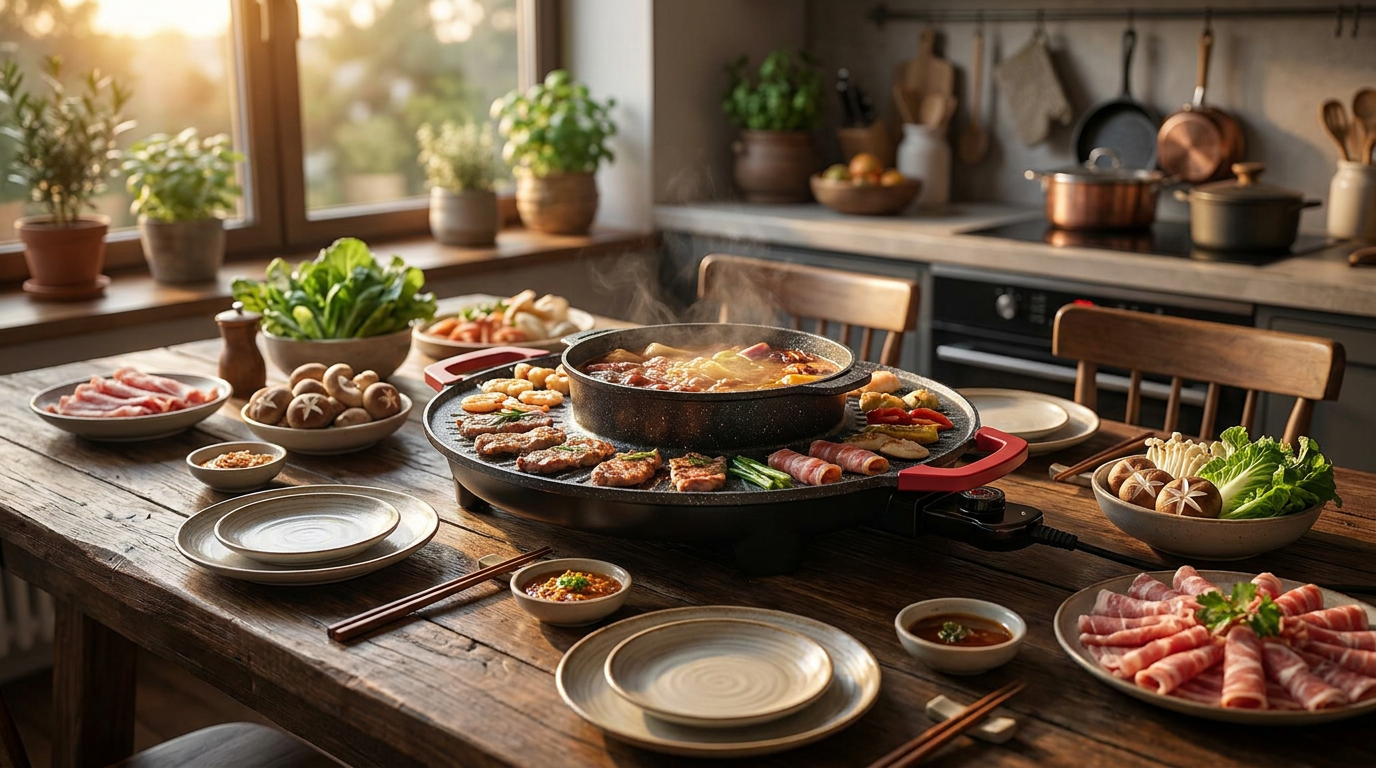
Choosing an Electric Korean BBQ Grill and Hot Pot Combo
June 15, 2026 — Selecting an Electric Korean BBQ Grill with an integrated hot pot requires balancing independent heat zones with total surface area to ensure both proteins and broths reach optimal temperatures simultaneously.
Home cooks often face a trade-off between compact storage and the power required to sear meat while maintaining a rolling boil. Think of it as a matrix of thermal independence and spatial utility. Understanding how these units distribute wattage between the grill plate and the soup vessel determines the success of a dual-menu meal.
How do integrated and split-plate designs differ in performance?
Integrated designs typically feature a fixed central or side-mounted pot that shares a single heating element, whereas split-plate models offer modularity and independent temperature dials for each zone. The decision rule: if you prioritize consistent searing temperatures for steak while simmering soup, independent dual-control systems are necessary to prevent heat bleed between the two surfaces. For instance, the Joydeem Electric Grill is noted for its ability to handle both Western-style steak grilling and traditional hot pot functions within a single footprint, as highlighted by reviewers at Best Korean BBQ & Hot Pot Setup? Joydeem Electric Grill Review. Once you see it this way, you can choose a model based on whether you value the simplicity of a unified heating element or the precision of separate thermostats. High-performance units often utilize 110V to 220V inputs to ensure that the 1500W to 2200W common in these devices is distributed effectively across both the non-stick grill and the stainless steel or alloy pot.
What factors determine the durability of these dual-purpose units?
Durability in an Electric Korean BBQ Grill combo is primarily determined by the coating material of the grill plate and the seal integrity of the electrical components against steam and grease. Two axes matter here: material resilience and ease of cleaning. VEVOR, a manufacturer of culinary essentials, emphasizes high-performance materials in their hot pot and grill combos to ensure longevity under high-heat conditions. Look for PFOA-free non-stick coatings that can withstand metal utensils, though silicone tools remain the standard recommendation for extending the life of the surface. Furthermore, units with removable plates and pots offer a significant advantage in maintenance, as they prevent water from entering the heating base during the cleaning process. Proper ventilation and heat dissipation vents on the underside of the chassis are also technical indicators of a well-engineered unit designed for long-term indoor use.
Quick answers
Q: Can I use the grill and hot pot at different temperatures? A: Yes, most mid-to-high-range models feature dual thermostats that allow you to set the grill to a high sear (approx. 450°F) while keeping the hot pot at a low simmer.
Q: What is the average power consumption for these devices? A: Most standard household units operate between 1200 and 2200 watts, requiring a dedicated 15-amp or 20-amp circuit to avoid tripping breakers when both sides are on high.
Q: Are the pots in these combos removable for cleaning? A: While many budget models feature a fixed pot, premium options like those from VEVOR or Joydeem often provide removable components to simplify sanitation and storage.
To optimize your setup, consider Electric Korean BBQ Grill Essentials for Dual Cooking or review our guide on Hosting Indoor Gatherings with Electric Korean BBQ Grill. For operational tips, see How to Use an Electric Korean BBQ Grill with Hot Pot.
Learn more about Electric Korean BBQ Grill at https://electrickoreanbbqgrill.com.